
What If You Could Play Civilization Without Micromanaging Every City?
Love Civilization but tired of repetitive city management? Explore Rule by Word, a strategy game in development built around your orders and their consequences.
A civilization strategy game could give you more time for decisions about food, expansion and trust by letting communities handle everyday work. You would set priorities, commit scarce resources and live with the consequences, while people continued the tasks they already knew how to do.
That is the idea behind Rule by Word, a turn-based historical strategy game we are building. You give orders in your own words, and a society with its own needs and limits attempts to carry them out.
When managing a civilization starts to feel repetitive
Choosing where to settle, what to build first and which neighbour to trust can be absorbing. These decisions give you a future to imagine. A small settlement might become a trading centre, a frontier outpost or the heart of your civilization.
Detail is part of that pleasure. Some players enjoy refining every city, and a well-timed adjustment can change a campaign. Repetition becomes a problem when you already know what you want to do, but must give the same instruction in five more places.
Firaxis identified this difficulty during the development of Civilization VII. In a 2024 developer diary, creative director Ed Beach described how growing empires create more cities and units to manage, while individual decisions can feel less significant.[1]
If you are looking for games like Civilization with less micromanagement, the time saved needs to leave room for interesting choices. What would deserve your attention next?
One food store and a difficult choice
The following scenario illustrates the current design for Rule by Word, which is in development.
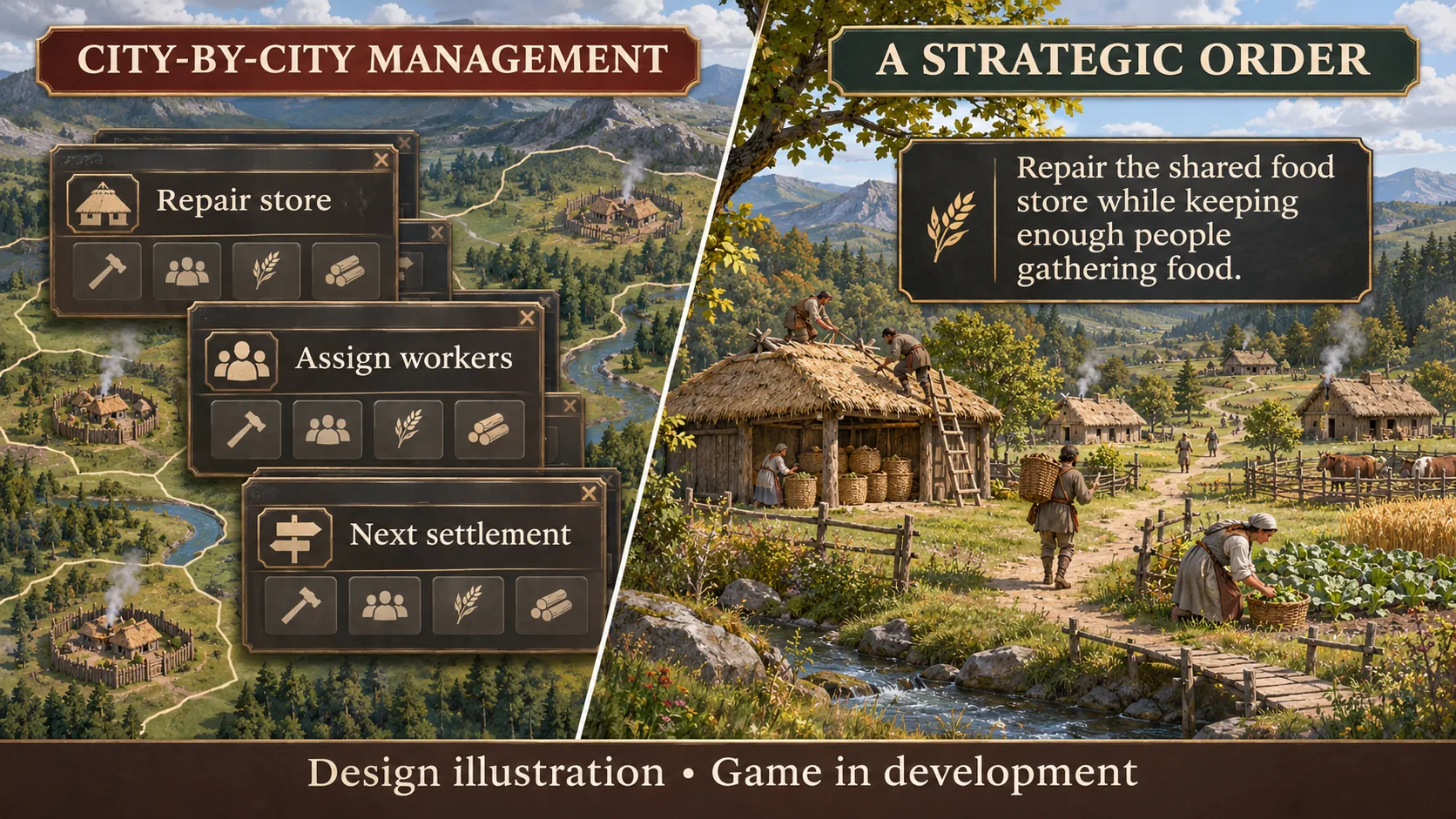
Imagine a community that has already learned how to gather food and maintain a shared store. Part of the store is damaged, and supplies are spoiling. The people who could repair it are also needed to bring in food.
In a game built around direct task assignment, you might select workers, order the repair, watch the food balance and reassign the workers afterwards. That can produce satisfying decisions when each step matters.
In Rule by Word, we are designing that intervention around an intention:
Repair the shared food store using timber we already have, while keeping enough people gathering food.
You have chosen to protect existing supplies and placed a limit on the labour available. A small repair may fit that limit; a full rebuild may not.
Before confirmation, the planned order preview would explain how the request has been understood, what it requires and which known constraints matter. If committing shared resources needs collective approval under your society's rules, the instruction becomes a proposal.
Perhaps people can repair only the worst damage. Less food spoils, but the work still uses timber and time that could have served other needs. You then decide whether the remaining risk is acceptable or deserves another intervention.
A lesson from early food storage
At Dhra', in present-day Jordan, archaeologists found purpose-built granaries dating to more than 11,000 years ago. Their raised floors helped with ventilation and protection against pests. These stores existed before fully domesticated cereals appeared in the region.[2]
For game design, this suggests a richer way to think about a familiar building. Secure food supplies depend on practical knowledge and organised work. Who contributes that work? How much can the community spare? Who has access to what is stored?
Those questions turn a storage problem into a decision about how people live together. They also give historical knowledge a practical use: an idea becomes valuable when a society can put it to work.
A society that keeps working
People should be able to continue gathering food and carrying out established commitments without a fresh instruction every turn. We are designing routine work, learned practices and feasible local initiatives to continue as turns advance.
Residents might notice an ordinary storage problem and repair it using resources they are entitled to use. A larger expansion could require them to ask for support or seek approval from a council, where one exists. The size of a project and the community's actual powers would matter.
Delegation therefore becomes a strategic choice. Giving a local body responsibility can create room for useful initiative, provided that authority is legitimately established. Its work still consumes materials and labour, and its decisions can turn out badly.
As more settlements develop, the aim is for routine repairs and food gathering to continue locally. Your attention would go to larger questions: which shortages need a shared response, where people should move and what each community can decide for itself.
Your people have reasons to agree or refuse
Now suppose the store serves two settlements. People farther away contribute to repairs, but supplies reach them less reliably. They may see the arrangement as unfair, even if the shortage began with a transport problem.
If you ask them for more work, their response should reflect what they have experienced. Earlier promises honoured could support cooperation. Repeated unmet needs could make agreement harder. A council with authority over shared reserves would have a say you could not remove simply by wording your order differently.
You would have several possible responses: change how food is distributed, reduce the demand for labour, seek agreement, or accept the consequences of keeping the policy. Your next decision grows out of what has already happened.
Cooperation matters just as much. A policy people consider fair may work well and leave you free to turn to something else. A living society needs room for useful compromise and quiet success.
An order needs a feasible way forward
Ordinary language should be enough to express an intention. The strategic work concerns timing, resources and limits. Before you commit, the game's interpretation needs to make those choices clear.
Writing "make sure nobody ever goes hungry" expresses a goal, but the society still needs a feasible way to pursue it. If people lack a reliable method of storing a certain food, an order cannot supply the missing knowledge.
The design allows experiments that consume time and resources and may fail. A useful discovery could become a practice that people adopt and continue. This is part of why we are building without a traditional technology tree: new possibilities should grow from what your society has actually learned.
Returning to the store, you might decide that repairing it is enough for now. Or you might later devote a decision to testing a better method. Both choices carry a cost because the same people have other work to do.
The repair should matter years later
If the store was repaired, that improvement should affect what the community can do next. If residents later enlarge it, the expansion should consume resources and change its capacity. Its history should let you follow those changes back to the people and decisions that caused them.
The promises made to get the work done belong to that history too. A community may remember that it helped another through a shortage, or that its own request went unanswered.
The wider design follows one continuing society from its prehistoric beginnings, with decisions accumulating as history advances. You continue directing the same society as generations pass and its institutions change. An old store might be adapted or abandoned. An arrangement that once worked might need to change.
A society that acts on its own also has to be understandable. The planned society overview would show known places, resources, practices and commitments, with a short account of what changed and more detail available when you want it. You should be able to decide what needs attention without rereading your society's entire history.
Help test this kind of strategy
The appeal is a civilization whose development you can recognise as the result of decisions made over time. The store beside the river might remind you of an early shortage, the people who solved it and an agreement that still shapes how food is shared.
That is the experience we are working toward. Rule by Word is in development, and the future alpha will help test how well these ideas work in play.
If this is the kind of strategy you want to test, join the alpha waitlist.
Sources
- Ed Beach, Firaxis Games. Civilization VII Dev Diary #1: Ages. 12 September 2024. Developer publication on Steam. ↩
- Ian Kuijt and Bill Finlayson. Evidence for food storage and predomestication granaries 11,000 years ago in the Jordan Valley. Proceedings of the National Academy of Sciences 106(27), 10966–10970 (2009). DOI: 10.1073/pnas.0812764106. ↩